

Notes from Bob Sabath:
Inner Practice and Movements Exercise
This week and over the next several weeks, we are going back to basics and will explore self-remembering as it relates to transformation:
“Some transforming agency must be formed at the place of the intake of impressions. This is the First Conscious Shock and it is given the general description of remembering oneself.”
There are many ways to “remember ourselves.” Gurdjieff introduced movements as work exercises. Though normally practiced in groups, there are some that are suitable for private, individual work. This week I want to introduce the First Obligatory. This is a movement that we can work with for the rest of this class. As you will see from the notes, this movement is almost the exact opposite of Movement #39.
As we begin to learn the gestures of this movement, we can experiment with taking fragments of the movement to help us “come back to ourselves” when we notice that we are gone — a simple arm gesture, head gesture, or leg gesture. If we make these gestures as part of our “returning to ourselves” we must not make them in a way that other people notice.
An added benefit of working with the First Obligatory is that combining arm, leg, and head movements cannot be done without Self-Remembering and getting all three of our centers involved in the movement.
We will continue with our core inner work practice that was given the first week, but this week will engage the practice as we begin to make a transition into the morning work for the day. If you wish, continue the practice as well at the other times as well, start of day, middle of day, end of day. Practice abbreviated forms of the practice — but enough so that all three centers are involved, and you sense and feel emotionally your presence and need for higher help. Don’t let the words get in the way. If Lord is problematic for you, use another of your choosing.
As a reminder, this is the core practice that we will use for the next 10 weeks:
Become aware of the natural flow of your breathing for a few breaths, noting the sensation or presence of the physical body as the air comes in and goes out. Relax the body as you breathe out.
Let a feeling of gratitude or wonder arise. Relax into a feeling of gratitude or wonder for life or for whatever you may feel gratitude for. Do this for a few more breathes.
For the next few breaths, say inwardly “I”, as you inhale, breathing with the intention of taking in finer energies or substances in the air and feeling a connection to Higher help. When you breathe out say inwardly “AM”, with an awareness of your whole body physical presence.
Finish in three breaths with Inner words: “Lord Help Me”; “Lord Help Us”; “Lord Have Mercy”.
The exercise itself is a form of self-remembering — returning from “all these other things” back to ourselves. Its aim is to practice three-centered awareness — observing (seeing), sensing, feeling. Engaging all three centers and having a sense of whole body awareness is essential. Activating gratitude, wonder, a sense of our own being, or our own inner poverty and need for higher help — all are good catalysts for self-remembering.
Continue to practice Movement #39 if that helps you. Parts of Movement #39 can be used as a bodily form of Self-Remembering.
As part of your practice this week, you might also explore connections between the weekly lectionary reading for the current week and the Nicoll commentary reading for this week, as well as choose a logion from the Gospel of Thomas as part of your weekly meditation.
Week Four Reading from Nicoll’s Psychological Commentaries
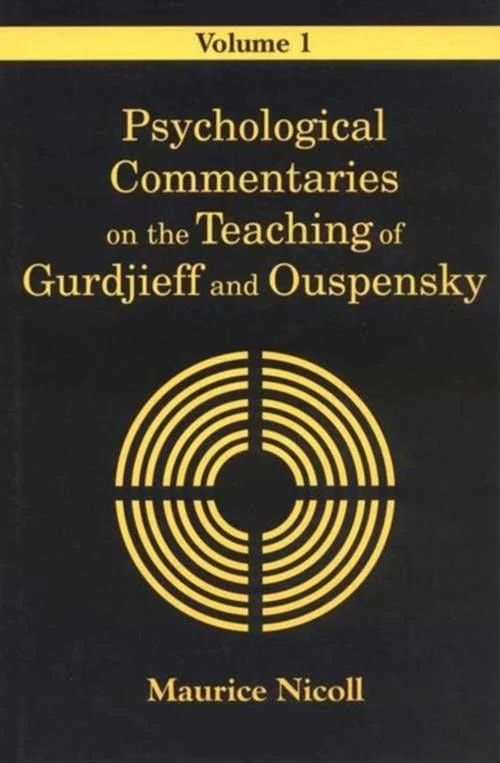
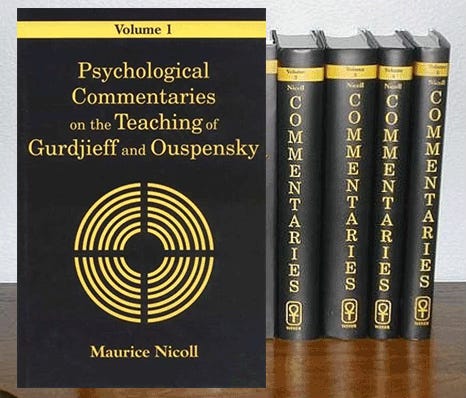
The following reading is taken from Maurice Nicoll, Psychological Commentaries on the Teaching of Gurdjieff and Ouspensky, Vol. 1, 1996 Edition: Samuel Weiser Inc., pp. 50-53.
NOTE: This week’s reading is edited to reflect more inclusive language.
The Idea of Transformation in the Work: Part 1
Psychological transformation
As some of you know, it has been suggested by Mr. Ouspensky that this work might be called by the name Psycho-transformism. The idea of the work is psychological transformation–the transformation of oneself.
Transformation means the changing of a thing into a different thing. Chemistry studies the possible transformation of matter. There are well known transformations of matter. For example, sugar can be transformed into alcohol, and alcohol into vinegar by the action of ferments: this is the transformation of one molecular substance into another molecular substance. In the new chemistry of the atoms and elements, radium slowly transforms itself into lead.
The language of alchemy
As you know, the transformation of base metal into gold has always been dreamed of as possible by the alchemists of the past. But this idea did not always have a literal meaning, because the language of alchemy was sometimes used by secret schools of teaching as referring to the possibility of the transformation of an individual into a new kind of person.
An individual as he or she is–that is, mechanical individual serving nature and grounded in violence–was represented as base metal and the transformation of base metal into gold referred to this possible transformation latent in them. In the Gospels, the idea of mechanical individual as a seed capable of growing has the same significance, as has also the idea of re-birth, of a person being born again.
We are a three-story factory
As you know, in this system of teaching, we are regarded as a three-story factory, taking in three foods–ordinary food on the lower floor of the factory, air on the second floor, and impressions on the third floor.
The transformation food
The food we eat undergoes successive transformations. The process of life is transformation. Every living thing lives by transforming one thing into another. A plant transforms air, water and salts from the earth into new substances–into what we call potatoes, beans, peas, nuts, fruit, and so on–by the action of sunlight and ferments. The sensitive living film spread over the earth, which conducts force from the universe–that is, organic life–is a vast transforming organ.
When we eat food it is transformed successively, stage by stage, into all the substances necessary for our existence. This is done by that mind called instinctive center, which controls the inner work of the organism and of course knows far more than we do about it. We can understand that when food is taken, digestion begins.
Digestion is transformation. The food is changed into something different in the stomach. This is only the first stage of the transformation of food and is designated in the work as the passage of coarse matter into finer matter (Do 768 to Re 384). It will be sufficient to use this first stage as an example without going further. It is a stage everyone can understand without difficulty.
Everyone can see that the food taken into the lowest compartment of the three-story factory–namely, the meals we eat–undergoes transformation. Now suppose the food passed into the stomach and nothing happened — what then? The body, which is like a huge town, will make no contact with it. How can an undigested piece of meat or a potato enter the blood stream and supply the necessary fine substance, say, to the brain?
The food of impressions
This situation is more or less the case, however, in regard to the third food, the food of impressions. They enter and remain undigested –that is, there is no transformation here. Impressions come in with a certain energy (as Do 48) and stop. Save for a very small amount of transformation, nothing takes place. There is no adequate transformation of impressions.
It is not necessary for the purpose of nature that we should transform impressions. But we can transform our impressions ourselves, if we have sufficient knowledge and understand why it is necessary.
Life comes in as impressions
Most people think that external life will give them what they crave and seek. Life comes in as impressions. The first realization of the meaning of this work is to understand that life, coming in as impressions, must be transformed. There is no such thing as “external life”. What all the time you are receiving is impressions.
You see a person you dislike–that is, you get impressions of this nature. You see a person you like–that is, you get impressions once more. Life is impressions, not a solid material thing such as you suppose and believe is reality. Your reality is your impressions.
I know this idea is very difficult to grasp. It forms a very difficult crossing-place. You are, perhaps, sure that life exists as such, and not as your impressions. The person you see sitting in a chair wearing a blue suit, smiling and talking, you think is real. No, it is your impressions of him that are real for you. If you had no sight, you would not see him. If you had no ears, you would not hear him.
The First Conscious Shock
Life comes in as impressions and it is here that it is possible to work on oneself–but only if you realize that what you are working on is not external life but the impressions you are receiving. Unless you can grasp this, you will never understand the meaning of what in the work is called the First Conscious Shock.
This shock relates to these impressions which are all we know of the outer world, that we are taking in, that we take as actual things, actual people. No one can transform external life. But everyone can transform their impressions, namely, the third and highest food taken in by the three-story factory.
It is necessary to create a transforming agency at the point of intake of impressions
For this reason this system of teaching says that it is necessary to create a transforming agency at the point of intake of impressions. This is the meaning of the work regarded in the light of psychological transformation and this is the point at which work begins.
It needs a conscious effort
It is called the First Conscious Shock because it is something not done mechanically. It does not happen mechanically–that is, it needs a conscious effort. A person who begins to understand what this means, at the same time begins to be no longer a mechanical individual, serving nature, someone asleep and merely used by nature for its own purposes.
Transforming impressions and the results of impressions
If you now think of the meaning of all you are taught to do in the way of effort, beginning with self-observation, you will see beyond any doubt that everything on the practical side of this work relates to transforming impressions and the results of impressions.
Work on negative emotions, work on heavy moods, work on identifying, work on considering, work on inner lying, work on imagination, work on difficult ‘I’s, work on self-justifying, work on states of sleep, and so on, is all connected with transforming impressions and the results of them.
Remembering yourself
So you will agree that in a sense work on oneself is comparable to digestion in the sense that digestion is transformation. Some transforming agency must be formed at the place of the intake of impressions. This is the First Conscious Shock and it is given the general description remembering oneself.
Taking life as work
If you can, through the understanding of the work, take life as work, then you are in a state of self-remembering. This state of consciousness leads to the transformation of impressions–and so of life as regards yourself. That is, life no longer acts on you in the old way. You begin to think, and to understand, in a new way. And this is the beginning of your own transformation. For as long as we think in the same way we take in life in the same way and nothing changes in us.
To transform the impressions of life is to transform oneself
To transform the impressions of life is to transform oneself, and only an entirely new way of thinking can effect this. All this work is to give you an entirely new way of thinking. Let me give you one example. You are told in the work that if you are negative it is always your own fault. The whole situation as recorded by the senses must be transformed. But to understand this, it is necessary to begin to think in an entirely new way.
Changing our reactions to life
You all can understand that life is continually causing us to react to it. All these reactions form our life–our own personal life. To change one’s life is not to change outer circumstances: it is to change one’s reactions. But unless we can see that outer life comes in as impressions which cause us to react in stereotyped ways, we cannot see where the point of possible change comes in, where it is possible to work.
Beginning to live more consciously
If the reactions that form your own personal life are mainly negative, then that is your life. Your life is chiefly a mass of negative reactions to the impressions that have come in every day. The transformation of impressions so that they do not always provoke negative reactions is then one’s task, if one wishes to work on oneself. But for this, self-observation at the point where impressions enter us is necessary. Then one can let the impressions fall in a negative mechanical way, or not. If not, then that is to begin to live more consciously.
Preventing impressions from having their full mechanical effect
If one fails to transform impressions at the moment of their entry, one can always work on the results of these impressions and prevent them from having their full mechanical effect. All this requires a definite feeling, a definite evaluation of the work, for it means that the work must be brought forward, as it were, to that point where impressions enter and are being distributed mechanically to their customary place in personality to evoke the old reactions.
We will speak later much more about transformation, but it can be added that no higher level is possible of attainment unless there is transformation, and the very idea of transformation is based on the fact that different levels exist, and refers to the passage from one level to another level of being. No one can reach a higher level of development without transformation.

Share your work with this week’s lesson
Join our Group Discussion in Facebook, join our substack group chat, or use the comments to share your work with this lesson.

← Previous Lesson | Table of Contents | Next Lesson →
Please note that the top or latest posts following comments are Daily Quotes, not lessons for this course.